Getting my London private hire driver’s licence involved more than filling in an application. I needed medical and background checks, supporting documents and three assessments—and later had to correct a small omission on my medical form.
I’m Evans Ofori. I submitted my application on 11 May 2026 and received the approval email on 6 August 2026: 87 calendar days later. My licence arrived by post about a week afterwards. My recorded costs came to £655.92.
This is the journey behind those numbers. Alongside my experience, I explain the official requirements that made each step necessary. The receipts and correspondence support my story; the linked official guidance helps you work out what applies to your own application.
My dates and payments are historical. Official guidance linked below was checked on 27 October 2026, and may differ from the guidance available when I applied. My waiting time is not an estimate for another applicant.
Watch my TfL licence journey
My TfL Licence Journey — Video Coming Soon
The full YouTube walkthrough will be embedded here when released. Meanwhile, read the verified story, dates and evidence below.
Getting my documents ready
Why the documents matter. TfL checks eligibility, identity and suitability. Its application guidance covers age, driving-licence history, right to work, character and medical fitness, and asks for consistent names on identity documents. Start with TfL’s application requirements and your portal checklist.
After checking TfL’s basic requirements, I decided to get my documentation ready before submitting my application.
My first step was to check my driving licence, GP records, bank records, proof of address—including electricity bills and council tax—and electoral registration. I updated records where needed so they showed the same current address.
This helped me prepare the supporting documents I would submit with my application.
The records I checked were not all documents I submitted directly to TfL. Checking my GP records, for example, was part of preparing for my medical.
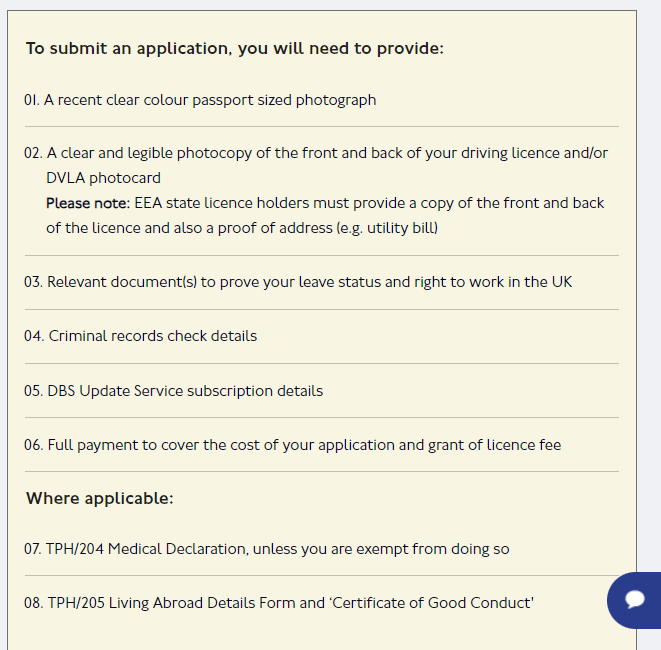
The Certificate of Good Conduct requirement did not apply to me. The checklist includes immigration/right-to-work evidence and, “where applicable”, the TPH/205 Living Abroad form with a Certificate of Good Conduct. I did not obtain a Certificate of Good Conduct because the requirement did not apply in my case—so my experience should not be treated as a complete document checklist for every applicant. TfL’s current guidance says new and renewing applicants who have lived outside the UK for one or more continuous periods of three months or more in the previous ten years—including extended holidays—must complete the TPH/205 Living Abroad Details Form and provide a Certificate of Good Conduct for each relevant country. Periods spent overseas before age 18 are excluded. See TfL’s Certificate of Good Conduct guidance and the current Taxi and PHV Driver Policy. Follow the current official instructions for your circumstances.
Guidance checked: 27 October 2026.
Preparing for my medical
TfL assesses medical fitness against DVLA Group 2 standards. This explains why an ordinary summary of my records was not enough for the licensing examination.
The official medical requirement. Unless an exemption applies, use TfL’s TPH/204 Medical Declaration. A registered medical practitioner, normally your GP, needs access to your full medical records and must carry out a physical examination in person. The form sets out exemptions, including certain existing Group 2 licence holders; check its instructions before booking.
Check the whole medical form for all required answers, applicant details, signatures, stamps and dates.
If you attend a separate eyesight appointment, take the TPH/204 form so the optician or optometrist can complete the vision section on page 9, including their signature, stamp and date, and your full name in block capitals. The doctor carrying out your medical examination must complete the remaining medical sections and declaration as required.
Source: TPH/204, June 2026 edition, checked 27 October 2026. This is the currently reviewed edition, not a claim that I used that edition before my May application.
What happened when I requested my records
When I first asked for my medical records, the GP reception desk gave me a local/summary record. I later found out this was not enough—the doctor needs the full medical history.
I then requested my full medical records. My lesson was to explain what the records were needed for and request them early. Getting them can take time.
I had my examination through my own GP surgery. I waited around two weeks for the appointment and paid £120. While waiting, I visited an optician to complete the vision section; that cost £25.
| My medical expense | What I paid |
|---|---|
| GP medical | £120 |
| Optician | £25 |
| Total | £145 |
Personal historical costs, confirmed by me. Receipts are not included.
Before booking, ask whether the provider completes TfL private-hire medicals, how the doctor will access your full medical records, whether the eyesight assessment is included, and what the appointment costs.
Official form guidance. Access to full medical records does not necessarily mean every applicant must carry a printed copy. Confirm arrangements with the examining practitioner before your appointment. Download the currently linked form from TfL. Read the form’s instructions.
The detail I wish I had checked
In my case, I visited an optician separately. My full name was missing from the vision page, which led TfL to request a correction. I did not notice the omission before submitting the form. The dated correspondence appears later in this story.
Check every required answer, name, signature, date and stamp before leaving.
My enhanced DBS check and Update Service
Why TfL requires this. An enhanced DBS check forms part of TfL’s assessment of an applicant’s character. Apply through the provider linked from TfL’s official application page. TfL also requires Update Service registration before granting a licence and a continuous subscription once licensed.
My application and identity check
I followed TfL’s website link to its authorised DBS provider, KnowYourPeople / First Advantage. For identity and address verification, I used my driving licence and a bank statement.
After completing the online part, I received instructions to select a participating Post Office for identity verification. Several branches were listed, so I chose the nearest one and went that same day. Staff scanned the supplied QR code, verified my details and checked my identity documents.
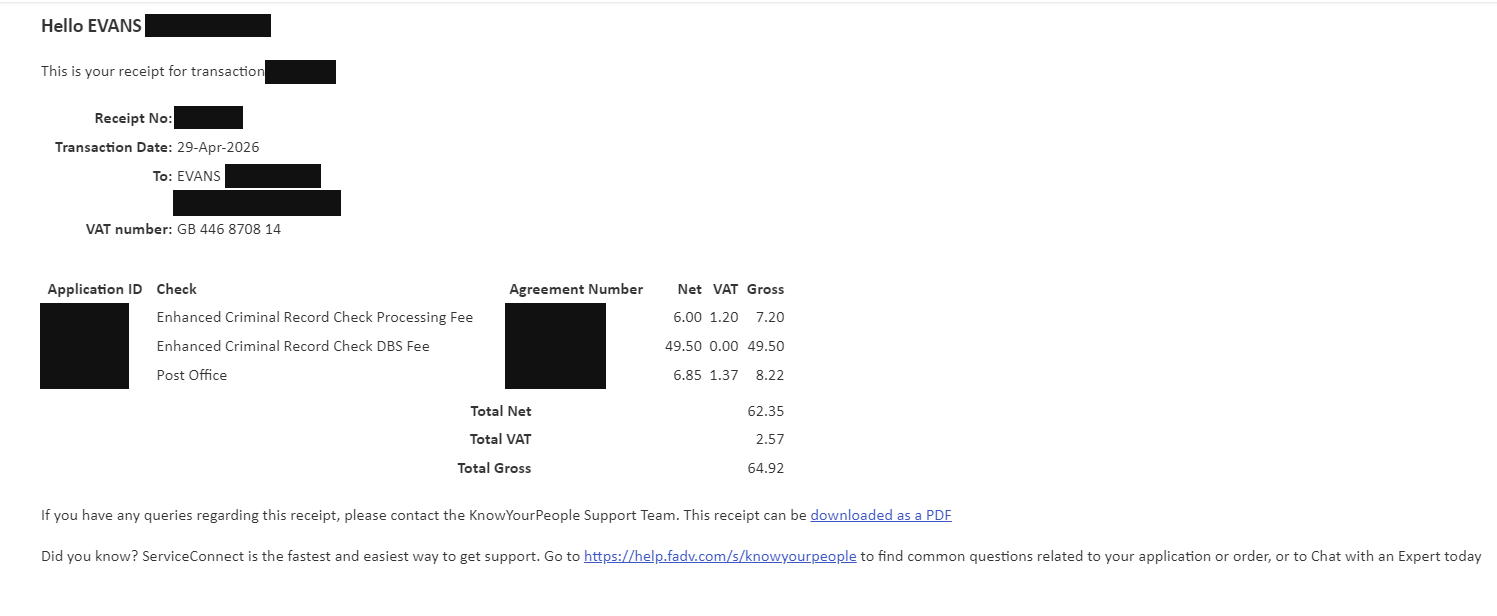
Cost breakdown: receipt dated 29 April 2026
| DBS component | Net | VAT | Gross |
|---|---|---|---|
| Enhanced Criminal Record Check Processing Fee | £6.00 | £1.20 | £7.20 |
| Enhanced Criminal Record Check DBS Fee | £49.50 | £0.00 | £49.50 |
| Post Office verification | £6.85 | £1.37 | £8.22 |
| Total | £62.35 | £2.57 | £64.92 |
These are the charges on my receipt, rather than a quotation of current fees.
Tip: remember to keep your DBS E-number
After completing your enhanced DBS application, keep the unique electronic application reference provided to you, known as your E-number. This identifies your DBS application.
When I completed the DBS section of my TfL application, my paper certificate had not yet arrived. I entered my E-number instead, which allowed me to submit my TfL application while waiting for the certificate.
Save your E-number as soon as you receive it so you can find it easily when completing your TfL application. Follow the instructions shown in the portal.
Registering separately for the Update Service
The DBS Update Service lets authorised organisations check whether information has changed since a certificate was issued. It is a separate subscription, not another name for the original enhanced check. Registration deadlines apply, so check the official instructions while arranging your DBS application.
I registered separately through the DBS Update Service online portal. My receipt confirms £16 paid on 11 May 2026.

Two separate steps. The enhanced check and Update Service subscription are separate. TfL requires registration and continuous subscription once licensed. Check the GOV.UK registration windows and current price before paying; my £16 is a historical payment, not a current quotation.
Creating my TfL account
TfL’s online application guidance explains that an account lets applicants submit an application and track progress. Here is how I used it.
I opened TfL’s Taxi and Private Hire portal and selected Register. I received an activation email, followed the link and logged in.
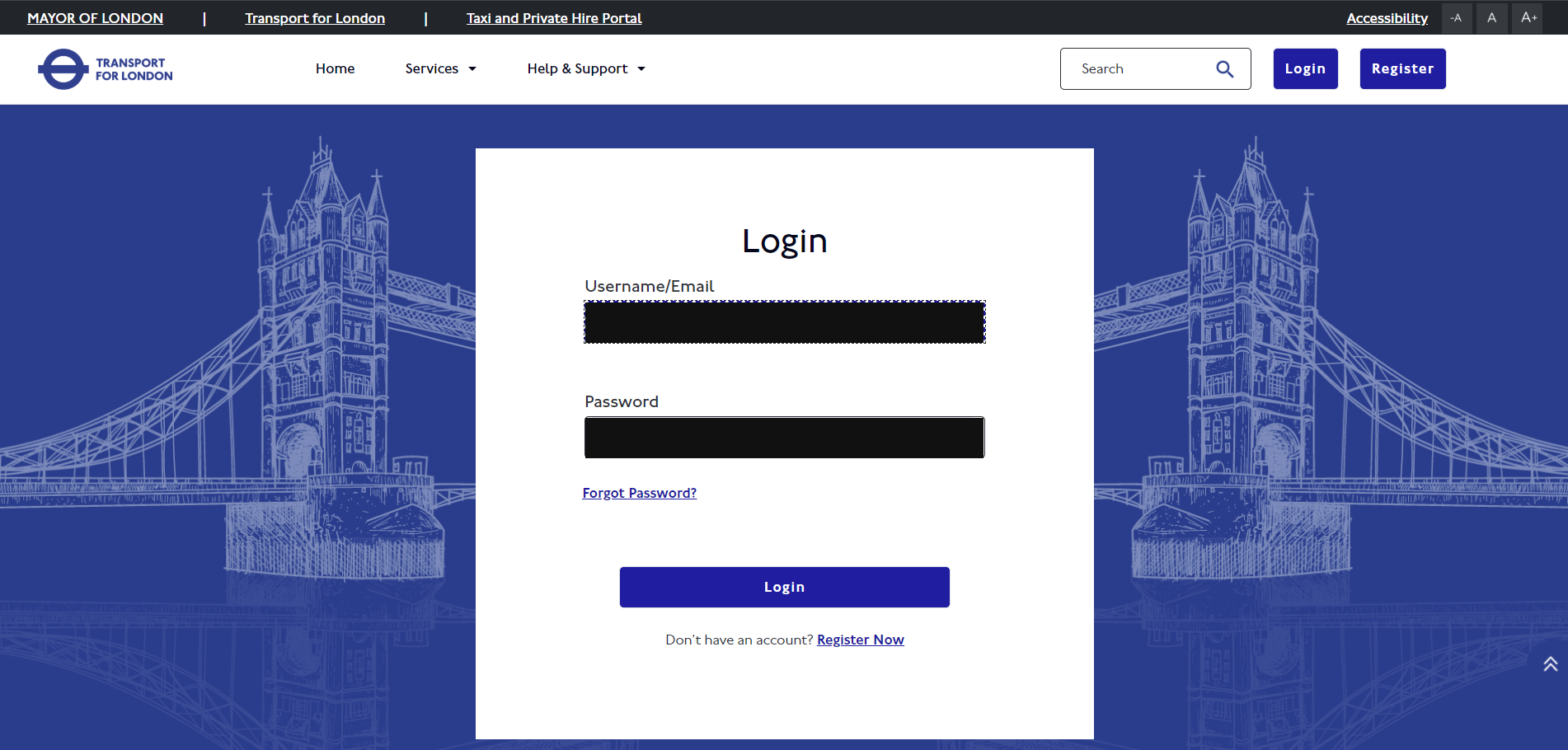
I worked through the sections in sequence, entered my details and uploaded the requested documents. I could save my progress and return later.
Saving and uploading did not mean I had submitted the application. Final submission was a separate step.
Paying and submitting on 11 May
I paid online on 11 May 2026. My receipt shows an application fee of £124 and a licence fee of £186—£310 in total.
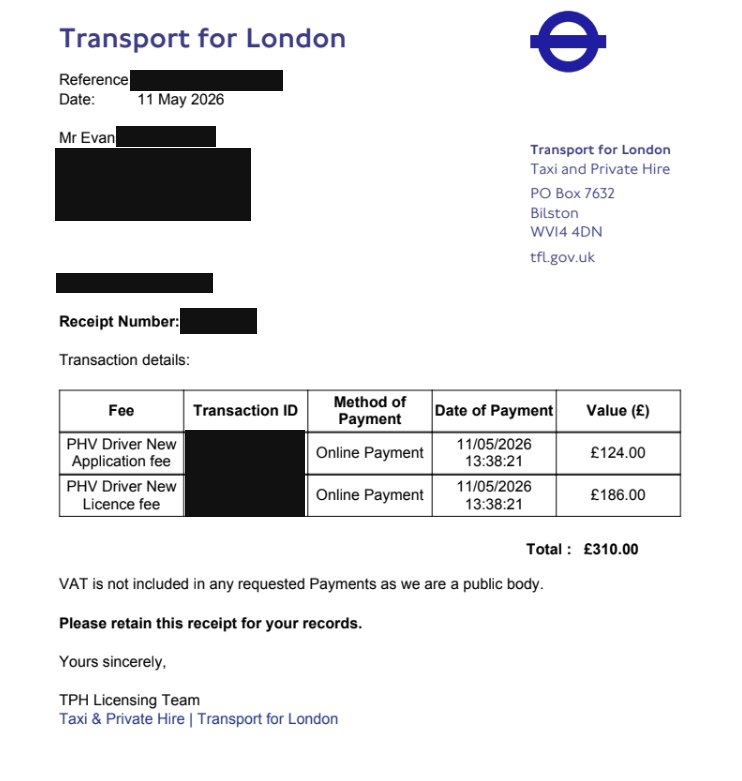
The confirmation email said my application had been submitted successfully. TfL aimed to carry out its initial assessment within 10 working days. That referred to the initial assessment, not issuing the licence.

Why I followed up after the initial assessment period
My submission confirmation said TfL aimed to carry out its initial assessment within 10 working days. By 28 May 2026, that period had passed and my portal still showed “Application Received.” I emailed to ask whether my application had been allocated for initial assessment and whether anything was outstanding.

About two days later, as I recall, TfL asked me to provide updated right-to-work evidence. I had already supplied right-to-work evidence with my application; this was a request for an updated version, not a document I had left out.
I generated a share code on the government website, saved the resulting document as a PDF and sent it as requested.
I believe my follow-up may have prompted someone to review my application and identify the need for updated evidence, although I cannot confirm that my email triggered the check.
My takeaway: following up may help. If the response period stated in your confirmation has passed without an update, a polite enquiry can help you find out whether anything further is needed. Keep your application reference and correspondence handy, and respond to any requests.
TfL checks applicants’ right to live and work in the UK. The evidence route depends on individual circumstances; the share-code request described here was what TfL asked for in my case.
Booking and preparing for my assessments
What the assessments are for
The assessments cover different skills needed for the role. TfL’s English language guidance explains the speaking and listening requirement and the use of SERU to assess reading and writing.
- Speaking and listening: communicating in English at the required level.
- Topographical skills: preparation includes using the computer-based format and plotting routes. TfL provides assessment guidance and a route-plotting video.
- SERU: understanding safety, equality and regulatory responsibilities, including safeguarding and passenger needs. TfL bases the assessment on its PHV Driver’s Handbook.
Use TfL’s SERU preparation page for the handbook and learning materials. That page also says applicants are expected to complete the online safeguarding awareness course before SERU. This is official guidance for readers; I have not separately documented that step in my own account.
My invitation and booking
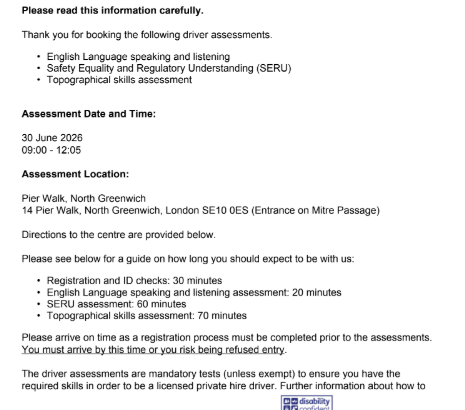
I received an invitation on 16 June 2026. It said the initial stages of my application were complete. I followed the link and booked all three assessments for 30 June 2026.
My appointment was at TfL’s North Greenwich centre, with a scheduled slot of 9:00 am–12:05 pm.
How I prepared
I started before the invitation arrived, reading the official SERU guide and watching YouTube videos. I also practised using serupractice.com.
Across the resources I explored, some information was older or missed updates. That made it important to return to official guidance when checking a requirement, rather than assume a practice resource was up to date. That experience helped inspire me to start building PHVDriverAcademy.co.uk. I am the person behind that project; this is not a claim that it is an official TfL service.
What assessment day was like
We were grouped on arrival, our documents were checked, and staff took us through in batches. Before the assessments there was another document check and each person had a photograph taken.
| Order in my appointment | My main lesson |
|---|---|
| 1. Speaking and listening | Focus on the audio in your headphones and your own responses. |
| 2. Topographical skills | Use TfL’s preparation materials beforehand and manage your assessment time carefully. |
| 3. SERU | Know the handbook, practise the areas you find difficult and work steadily. |
Speaking and listening: staying focused despite the voices around me
Other candidates were speaking at the same time during my assessment. I had to concentrate on what I could hear through my headphones and on giving my own responses, rather than getting distracted by the voices around me.
You may find it easier to concentrate in that setting than I did. My advice is to be prepared for other people speaking nearby: keep your attention on what you hear through your headphones and respond clearly.
Topographical skills: prepare for the format and protect your time
Before the topographical assessment, we received instructions and a walkthrough. I recognised the format from the public practice material on TfL’s website. Even so, I spent too long early in the assessment. By the later route-drawing questions, I was running short of time and rushed my last question.
My advice is to read TfL’s topographical assessment guidance and watch its route-plotting video before attending. Listen carefully to the walkthrough, then use your assessment time carefully. Familiarity with the format can help you spend more of that time answering the questions.
SERU: applying the timing lesson and knowing the handbook
After running short of time in the topographical assessment, I paid closer attention to my pace during SERU. I worked steadily from the start.
During my SERU assessment, we were given a guidebook to consult. I noticed some other candidates going back and forth through it. I had read the official guide several times and practised questions beforehand, so I felt familiar with the material and found the assessment manageable. I finished about 20 minutes before the time was up.
For me, the benefit of preparation was being familiar with the material before I entered the room. Having a book available did not replace that preparation. Use the official SERU handbook and preparation resources, practise questions and return to topics you find difficult.
Everyone is different. Finishing early was my experience, not a target you need to match. Give extra practice time to whichever assessment or topic you find hardest, and use the time available to read and answer carefully.
I paid £40 per assessment—£120 total. I have not located the receipt; these amounts are confirmed from my recollection.
Passing all three assessments
My outcome letter was dated 14 July 2026, two weeks after assessment day. Its date does not establish the exact day I received it.
| Assessment | My result |
|---|---|
| Topographical skills | Pass — 80% |
| English speaking and listening | Pass — 70% |
| SERU | Pass — 92% |
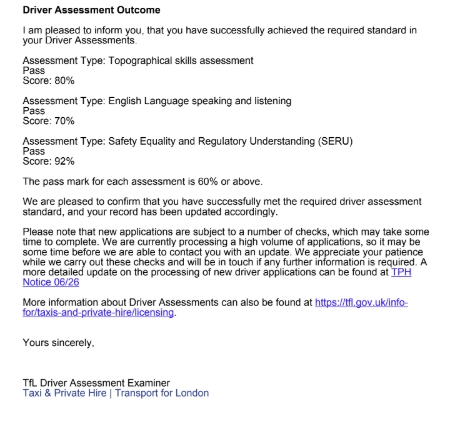
Passing did not mean my licence was ready. TfL explained that other application checks still had to be completed.
A medical paperwork correction after my assessments
On 23 July 2026, TfL wrote to say my application remained incomplete: my full name was missing from the vision page of TPH/204.
The letter asked the optician to add my name and then sign and stamp the page again. It gave me 28 days to provide the information.
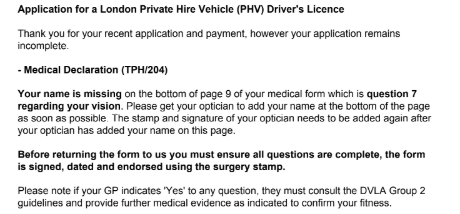
I returned to the optician and emailed the corrected form on 27 July, four days after the letter.

On 29 July, the portal still showed “Awaiting Further Information,” so I followed up to ask whether the page had been received. TfL acknowledged receipt after this follow-up; the acknowledgement date remains unconfirmed.

I believe this correction added some time, but cannot say how much. Checking the name field first would at least have saved me another visit and a resubmission.
Receiving my approval and licence
On 6 August 2026, TfL emailed to confirm my application was successful and my licence had been granted. It said the licence would arrive by post shortly, with instructions to contact TfL if it did not arrive within 10 working days.

My licence arrived about a week later. I do not remember the exact delivery date.
From submission on 11 May to the approval email on 6 August, my application took 87 calendar days.
My application timeline
| Date | Milestone | Basis |
|---|---|---|
| 29 April 2026 | Enhanced DBS payment and provider submission confirmation | Receipt and email |
| 11 May 2026 | TfL application submitted/paid; Update Service payment | Receipts; my account |
| 28 May 2026 | Initial-assessment follow-up | Sent email |
| About two days later | Request for updated right-to-work evidence | Recollection; date to verify |
| 16 June 2026 | Assessment invitation received | Letter; receipt date confirmed by me |
| 30 June 2026 | All three assessments taken | Booking letter; my account |
| 14 July 2026 | Outcome letter dated: three passes | Outcome letter |
| 23 July 2026 | Medical correction letter dated | TfL letter |
| 27 July 2026 | Corrected form emailed | Sent email |
| 29 July 2026 | Medical correction follow-up | Sent email |
| 6 August 2026 | Approval email | TfL email |
| About a week later | Licence arrived by post | Approximate recollection |
What I paid
| Expense | My historical cost | Evidence |
|---|---|---|
| Enhanced DBS process | £64.92 | Receipt |
| Update Service, one year | £16.00 | Receipt |
| GP medical | £120.00 | Confirmed recollection |
| Optician | £25.00 | Confirmed recollection |
| TfL application and licence | £310.00 | Receipt |
| Three assessments | £120.00 | Confirmed recollection |
| Total recorded costs | £655.92 | Mixed evidence as listed |
These are my costs, not a current quotation. The total excludes training, study materials, travel and any other expenses not recorded here.
What I would tell someone starting now
Start with TfL’s official guidance, prepare the right documents and check the details before submitting. Keep your records organised, follow up when necessary and give yourself time to prepare for the assessments.
Some discussions I read in public forums made the process sound daunting. In my experience it was more manageable than I expected. There were waits and a correction, but taking it step by step helped me get through it.
Your experience and waiting times may be different. I hope sharing mine helps you approach the process with a clearer idea of what to expect.
Official sources
- TfL: apply for a private hire driver licence
- TfL Taxi and Private Hire portal
- TfL: TPH/204 Medical Declaration
- GOV.UK: DBS Update Service
- GOV.UK: proving right to work
Official guidance checked on 27 October 2026. Links within each section explain the relevant requirement. My receipts establish historical payments; they do not establish today’s prices. Recheck live guidance before applying.